


A cost consultant advises clients on the financial side of a construction project, from the first discussions about budget through design, procurement, construction and final account.
You may also hear a cost consultant called a quantity surveyor (QS). The terms are often used interchangeably, although individual firms may describe their services slightly differently.
A good cost consultant gives you clear information about what your project is likely to cost, where the financial risks sit, how design decisions are affecting the budget and what is changing as the project progresses.
For refurbishment and retrofit projects, that role usually starts well before there is enough design information to produce a detailed cost plan.
When does a cost consultant get involved?
Ideally as early as possible. One of the most useful points to appoint a cost consultant is when you’re still working out what you want the project to achieve.
At that stage you might have a building, an initial brief and an idea of how much you’re prepared to spend. You may also have several options that you’re considering.
The cost consultant can test those options and give the project team cost information before significant design decisions are made.
For example, a business considering an office refurbishment might be deciding between refurbishing its existing space, reducing the amount of space it occupies or moving into another building.
Those options have very different cost implications. Understanding them early can prevent a lot of design work being spent developing an option that doesn’t fit the available budget.
What does a cost consultant do before design starts?
Early cost advice will depend on how much information is available.
It could include:
- helping establish the overall project budget
- preparing high-level cost estimates
- comparing different project options
- advising on likely construction inflation
- identifying significant cost risks
- advising on surveys and investigations that could reduce uncertainty
- benchmarking the project against similar schemes
- advising on procurement and tendering
- helping the client understand which costs sit outside the main construction contract
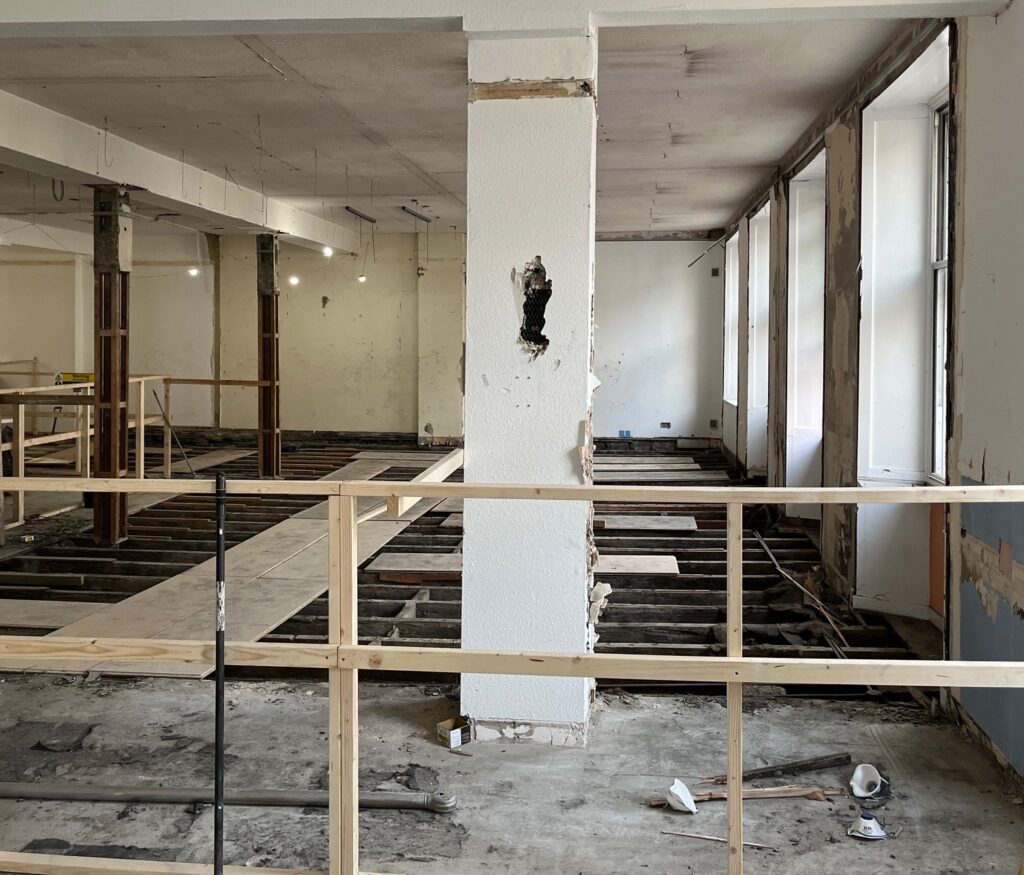
This stage is particularly important on refurbishment projects because you’re working with an existing building.
The condition of the building, existing services, structure, façade, asbestos, access restrictions, occupation and previous alterations can all affect cost.
The more you understand about those things before fixing the budget, the better informed that budget can be.
What does a cost consultant do during design?
As the design develops, the cost information should develop with it. The cost consultant will usually prepare and update a cost plan. This breaks the project cost into elements so the client and design team can see where money is being spent.
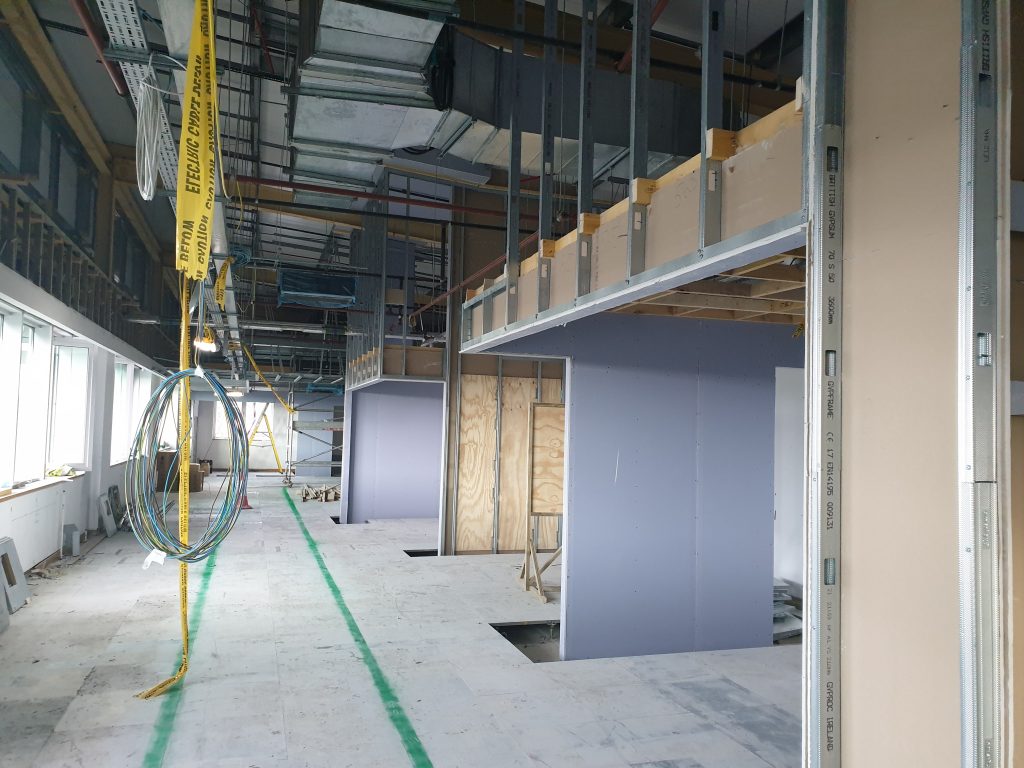
For an office refurbishment, for example, the cost plan might separately identify costs for partitions, ceilings, finishes, mechanical services, electrical services, furniture and other elements of the works.
That makes it easier to understand the financial effect of design decisions. If the mechanical design changes, you can see the cost effect. If the specification for finishes changes, that can be assessed too. This allows the team to make decisions while there is still time to do something about them.
Does a cost consultant just tell you what the design costs?
There is more to the role than producing an estimate. Cost consultants should be involved in conversations about design, risk, procurement, programme and the project brief because all of those things can affect cost.
If an estimate shows that a project is heading over budget, simply reporting the higher number doesn’t solve much.
The useful work is understanding why the cost has changed and what options the client and design team have.
That could mean reviewing specifications, challenging allowances, looking at alternative solutions, investigating an existing-building risk or deciding that additional budget is justified because a particular part of the brief is important to the client.
Good cost advice gives the client enough information to make that decision.
What does a cost consultant do during tendering?
Once the design has reached the appropriate stage, the cost consultant will usually be heavily involved in obtaining prices from contractors.
Depending on the procurement route, this can include:
- preparing pricing and tender documents
- advising on the tender list
- issuing cost information
- responding to commercial tender queries
- reviewing and comparing contractor prices
- identifying qualifications and exclusions
- checking that contractors have priced the same scope
- negotiating tender adjustments
- preparing a tender report and recommendation
The cheapest tender isn’t automatically the best tender. A price can be lower because a contractor has found a more efficient way of delivering the work. It can also be lower because something has been excluded, misunderstood or inadequately allowed for.
Part of the cost consultant’s job is understanding what sits behind the numbers before a client enters into a construction contract.
What does a cost consultant do during construction?
Once work starts on site, the focus moves towards managing and reporting the financial position of the project.
Typical activities include:
- assessing monthly contractor applications for payment
- valuing changes to the works
- reviewing quotations
- reporting committed and forecast costs
- monitoring contingency and risk allowances
- advising the client on the cost effect of proposed changes
- forecasting the likely final cost
- maintaining records of financial decisions
- agreeing the final account
A client should be able to understand what they have spent, what they have committed to spend and what the project is currently forecast to cost.
Knowing that a project was on budget 3 months ago isn’t particularly useful if a series of changes have happened since then. Cost reporting needs to reflect the current position.
What is the difference between a cost consultant and a quantity surveyor?
In practice, they are very much the same thing. Quantity surveying is the established professional discipline. Cost consultant is a term commonly used for consultants providing commercial and cost management advice on construction projects.
At Torridon, whilst we refer to ourselves as cost consultants, our work includes traditional quantity surveying activities such as measurement, tendering, valuations and final accounts, alongside wider advice on project budgets, risk, procurement, cost planning and cost reporting.
How does a cost consultant help control construction costs?
Cost control starts with a credible budget. That budget needs to reflect the client’s brief, the information available about the building, the design, the likely procurement route and the risks that can reasonably be identified at that stage. From there, costs need to be updated as information changes.
If a client increases the scope, there should be a cost attached to that decision. If surveys identify an issue with the existing building, the financial effect should be assessed. If a design decision reduces cost, the forecast should reflect the saving.
This creates a record of how the project has moved from its original budget to its current forecast. It also gives the client an opportunity to make decisions before costs become committed.
Why is refurbishment cost consultancy different?
Refurbishment projects contain uncertainty that you don’t encounter in quite the same way on a new-build project. You are dealing with an existing building, and you won’t always know everything about it when the project begins.
Existing services may need replacing. Previous alterations might not match the drawings. Structural elements can be concealed. Asbestos may be present. Existing finishes can hide defects.
A cost consultant with refurbishment experience should understand where those risks commonly arise and make sensible allowances for them.
They should also work with the wider project team to identify where further surveys, opening-up works or investigations could give the client better information.
Spending a relatively small amount investigating a risk early can sometimes prevent a much larger cost becoming apparent during construction.
How much does a cost consultant cost?
Cost consultant fees depend on the size, complexity and duration of the project, the services required and the stage at which the consultant is appointed.
Fees might be agreed as a fixed fee, a percentage of construction cost, a time-based fee or a combination of these depending on the commission.
The cheapest fee doesn’t necessarily result in the lowest overall project cost.
The more useful question is what service is included in the fee and what information the client will receive throughout the project.
We cover this separately in our guide (coming soon!): How much does a quantity surveyor cost?
Do I need a cost consultant?
For a small and straightforward construction project, you may decide that separate professional cost advice isn’t necessary.
As projects become larger, more complex or carry greater financial risk, independent cost advice becomes increasingly useful.
It is particularly relevant where:
- you need to establish whether a project is financially viable
- there is a fixed or limited budget
- you’re comparing different design or property options
- you’re refurbishing an existing building
- the project contains significant unknowns
- you’re tendering works competitively
- you need regular reporting to a board, funder or other stakeholders
- changes need to be controlled during construction
The cost of appointing a cost consultant also needs to be considered against the value of the decisions being made. On a £5 million refurbishment project, relatively small percentage movements in construction cost can represent significant sums of money.
When should I appoint a cost consultant?
The earlier a cost consultant understands the project, the more opportunity they have to influence its financial outcome. You don’t need a finished design.
In many cases, appointing a cost consultant while the brief, budget and initial options are still being developed gives the client useful cost information at the point when the biggest project decisions are being made.
That continues through design, procurement and construction, with the level of detail increasing as the project develops.
What does Torridon do as a cost consultant?
Torridon is a quantity surveying and construction cost consultancy specialising in complex refurbishment, retrofit and fit-out projects. We work with clients from the earliest stages of a project through design, procurement, construction and final account.
Our work typically includes feasibility and early cost advice, cost planning, risk management, procurement advice, tendering, contract administration support, valuations, change control and financial reporting.
A large part of our work involves existing buildings, particularly commercial offices. That experience matters because refurbishment costs are heavily influenced by what is already there, what condition it is in and how much is known about the building before construction begins.
Our aim is to give clients better information about their construction costs so they can make better decisions throughout the project.
About the author

David Shaw
Director at Torridon | Chartered Quantity Surveyor
Cost consultancy expert specialising in commercial refurbishment and fit-out projects
Get in touch: